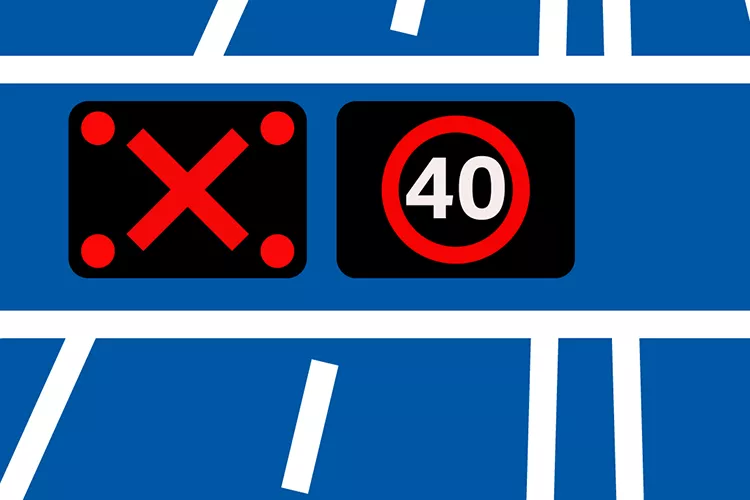
Traffic Scotland’s Control Room Operators often witness drivers on CCTV ignoring the Red ‘X’ signal on motorway signs. This puts other drivers, road workers, emergency services and anyone involved in the incident at risk.
The campaign comes after the trial of the new automated vehicle restraint barrier system on either side of the Queensferry Crossing in November 2023. These barriers will allow M90 traffic to be diverted via the Forth Road Bridge more rapidly, should the Queensferry Crossing need to be closed for any reason.
When preparing to move the barriers into place, a Red ‘X’ sign is shown across all lanes on the motorway signs, directing users to stop until the movement of the barriers is complete. Only once all traffic has stopped will the automated barriers be moved.
It is illegal and dangerous to ignore the Red ‘X’. If a road user fails to stop and is caught, there is the risk of a £100 fine and three penalty points.
While traffic on the south approach to the bridge stopped when the Red ‘X’ signs were shown, the north approach unfortunately were not so quick to comply. This lengthened the time it takes before traffic is permitted to use the Forth Road Bridge, further delaying road users on the M90.
Chris Tracey, BEAR Scotland’s South East Unit Bridges Manager, said: “Crucially, it is now faster to redirect M90 traffic onto the Forth Road Bridge than it is to divert via the Kincardine Bridge, so this will be the default process from now on if the Queensferry Crossing has to close for any reason.
“There are limits to how quickly the diversion can be opened, as traffic management must still be put in place to close slip roads at Queensferry and Ferrytoll and traffic already on the Queensferry Crossing must be given time to clear the bridge, however our aim is to speed up the overall process as much as possible and we learned a lot from this trial that will help us to do this.
“One of the biggest areas for improvement was in the time it took for traffic to comply with Red ‘X’ signs on the overhead gantries. These instructions to stop are mandatory and we’ll provide any assistance we can to help Police Scotland enforce them.”
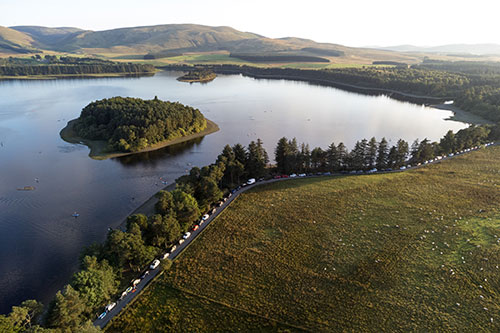
Midlothian photographer and regular wild swimmer at Gladhouse Lee Live took this photograph from his drone at the reservoir which shows cars parked along the northern end of Gladhouse reservoir.
Parking restrictions are to be implemented around the northern end of the Gladhouse reservoir in Midlothian. This means that visitors and users of the reservoir will now find it difficult to park there legally.
A Midlothian Council spokesperson said:
“From Monday 11 April, temporary parking restrictions will be in place along part of the U80 Gladhouse Road on a stretch of the road along the northern shoreline of Gladhouse Reservoir. The temporary restrictions will be monitored throughout the period to 2 October and are in response to safety concerns raised by our emergency partners concerning access in the event of an incident or emergency, due to the volume of parked vehicles.
“While encouraging activity and wellbeing, public safety remains the priority. Drivers can still park outwith the designated clearway and we encourage visitors to do so with due care and consideration. As this is an operational and public safety matter, ward councillors were advised of the temporary traffic order as it was issued.”
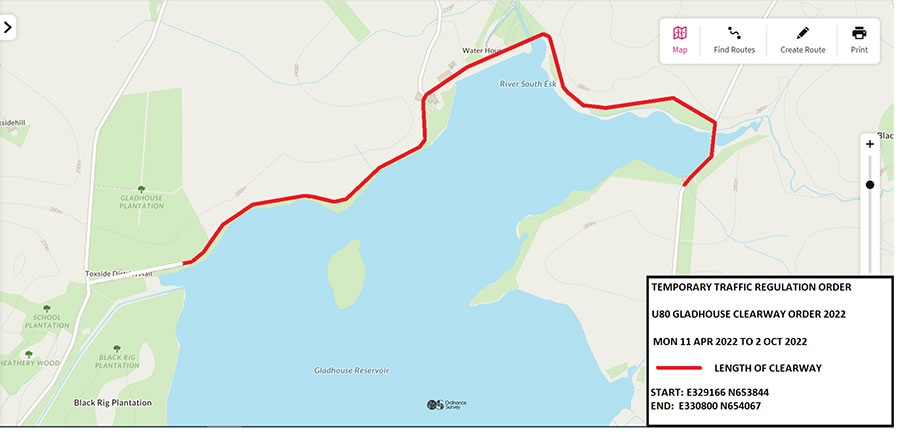
The map shows the area covered by the Clearway.
Midlothian Conservative Councillor and Provost Peter Smaill is not quite sure that the parking restrictions are the answer. He told Midlothian View:
“Councillors like me who discussed the undoubted problems associated with Gladhouse took away an impression that the proposed Toxside car park would be constructed simultaneously with introduction of parking restrictions.
“The car park will now not happen this year but a comprehensive ban on parking will immediately come in.
“The assumption now being made that the established public demand for access will somehow be able to find alternative parking is highly questionable. The Council does not have the resource in my opinion to monitor and enforce the freeway adequately.
“I understand the demand of locals for their amenity to be considered more important than public access. The emergency vehicle/safety issue applies on many country roads as narrow as this road becomes, and I await convincing evidence on that point that a total parking ban is necessary on this stretch of the road.
“It is a question of balancing interests and right now one group is being heard loud and clear and another in practical terms seems to ignored. We need an equitable and practical answer.”
Regular wild swimmer at Gladhouse Lee Live said
“It seems that this is the council’s response to an incident whereby an emergency vehicle couldn’t get through the road. Sadly, the newly proposed car park has not been built and so the question is where are all these cars going to go?
“I believe that this is only going to lead to issues between users of the reservoir and residents whom I suspect will become deeply frustrated as car owners block other roads leading to Gladhouse.
“It could be a blessing in disguise as this Clearway will send a message far and wide that Gladhouse is closed. After all, the place was filled with litter and glass last year, folk were defecating on the banks, idiots were chopping down trees for fires and even setting the bank alight, I was told that campervan owners were emptying their chemical toilets into the water.
“But, it’ll be sad for all those conscientious nature lovers who abide by the rights of the Outdoor Access Code and love to swim and paddleboard there as it was the only place with direct access.”
Midlothian View asked Scottish Water for an update on the car park, their spokesperson said;
“Scottish Water understand the challenges around parking in the area. With this in mind we are still working on plans for a new car park. We do not currently have a date for this but will issue an update as soon as we have indicative dates.
“Please be assured, we recognise the importance of accessibility at our reservoirs and are using information from a user survey carried out last year to develop ways to improve the site for visitors.
“We are continuing to work with Midlothian Council, Police Scotland, Scottish Fire and Rescue Service and others to establish ways of providing safe access to the reservoir.”
Hugo Foley, co-founder of Driftwood Adventures, an outdoor activities company who regular take customers to Gladhouse for water sports, said:
“Gladhouse Reservoir is a fantastic location for those of the Lothians and Edinburgh to enjoy. It has become something of a lifeline for those living nearby over recent years with the covid outbreak and travel restrictions.
“I was amazed to learn about the proposed ban on parking before a car park could be provided. People have been restricted for long enough. Depriving people of this beautiful place in a time where we are supposed to be encouraging people to get outdoors seems completely unjust.
“As a watersports provider at Gladhouse I have seen some irresponsible people who have caused contention between themselves and the local people who live there and I understand the strain this puts on the local residents.
“However I have also seen thousands of people over the last two years using the place correctly, responsibly and safely. My company has had several successful litter picks at Gladhouse with people invited along to help us look after such a beautiful location and give back to a place that offers so much.
“There has to be a solution however I strongly believe banning parking entirely is not it.”

Celebrate the contribution that different groups make to their communities by getting involved with Equal Midlothian Week, 4-9th March 2019.
The purpose of Equal Midlothian Week is to raise awareness of equality issues and to promote a more equal Midlothian.
A range of organisations working on equalities issues will be holding events during the week to highlight the work they do to create a fairer, more inclusive Midlothian. This includes sessions about cultural awareness, disability, mental health, kinship care, domestic abuse and LGBT issues.
The week culminates with the Midlothian Mela event in the The Gorebridge Beacon (Hunterfield Road, Gorebridge, EH23 4TT) on Saturday 9th March. This annual event features music, dance, artistic performances, workshops and food. There will also be activities for adults, young people and children. Come along to this family friendly event and celebrate the work people do on equalities in Midlothian.
Midlothian’s Equalities Champion Kelly Parry said:
“Find out more about equalities work in Midlothian by popping in to some of the free events being held during the week. Not only will you get to find out more about Midlothian’s diverse population but you will also have an opportunity to meet new people. The highlight of the week is the Mela which has become a popular annual fixture. This event for all ages and interests provides a great opportunity to socialise.”
You can see the full programme at www.midlothian.gov.uk/equal-midlothian
Equal Midlothian Week in Midlothian is supported by the Midlothian People’s Equality Group and Health in Mind.
For more information on Equal Midlothian Week, please contact Erin Cuthbertson on: 0131 271 3358, Erin.Cuthbertson@midlothian.gov.uk