A push for more power over vital decision that affect local towns and villages to be handed over to community councils, is set to be made at a national conference.
The Joint Forum of Community Councils in West Lothian said this week the time has come for community councils to have a greater say in issues which affect communities. and should have powers over planning decisions, town centre development as well as handling grants and other financial support for community groups.
There’s no reason, the Forum believes, that community councillors cannot take on many of the decision making responsibilities currently held by the 32 local authorities in Scotland.
The devolution of responsibility would be a boon in communities which have strong local identity and long established and active community councils, in towns such as Bathgate and even small villages such as Dechmont.
While the growth of community councils has been positive across West Lothian, there are some areas where it has been hard to sustain councils.
Critics say that in many areas, as with other elements of civic life, the “pool” of interested people willing to play an active role in the community tends to be small and distinct.
The Forum has invited community councils from across Scotland to join an online conference to look at ways in which the bodies, first set up fifty years ago can take on more powers to further localise decision making.
Launching the conference date for 10 June the Forum said: “West Lothian Community Councillors had an in depth debate at a conference on the subject and that produced a Blueprint for Future Community Councils calling for more responsibility and powers to be devolved to communities.
“We discussed the Blueprint with our local Council Officers and COSLA officials and put it forward as a contribution to the then ongoing examination of new arrangements for local democracy. The pandemic brought all that to a shuddering halt in 2020.”
The Forum added: “We think that it’s time to resuscitate the discussion particularly in the year when we will be celebrating the 50 year anniversary of the birth of Community Councils. In fact, we cannot think of a better subject for this anniversary year. So, we thought that we should make it a Scottish wide discussion for all Community Councillors, hence this invite.”
Community Councils have survived for 50 years, having been established in 1973, with little or no change to their powers or responsibilities since then. In that time local Councils have undergone a massive reorganisation from 9 regions and 53 districts and 3 Island Councils in 1973, into 32 unitary Councils in 1996.
A Forum spokesman said “No change was made during that reform to Community Councils, which in retrospect is surprising. This is an invitation to join us and Community Councils from all over Scotland for a discussion online on whether or not Community Councils should be part of a new system of devolved government and if we should form a Scottish Community Councils Forum group.”
The Forum has also invited COSLA, the umbrella organisation for the 32 Scottish local authorities and the Scottish Government.”
To register an interest in the conference, email westlothiancc@gmail.com.
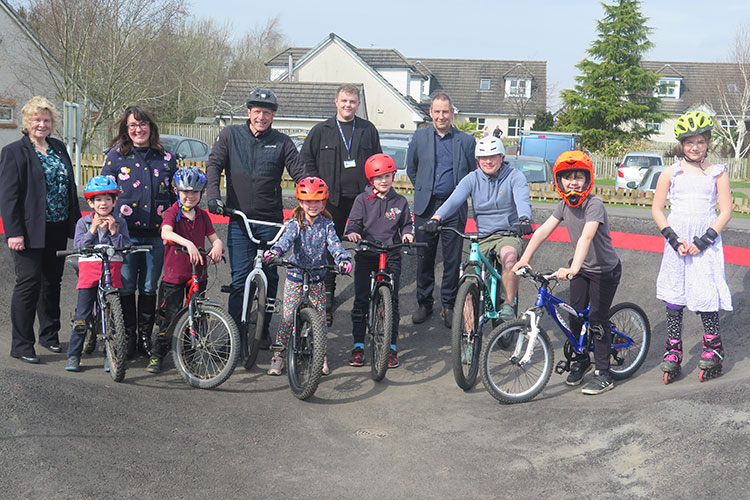
Left to right are: Midlothian Council's Cabinet Member for green spaces, Cllr Dianne Alexander, Robert, 7, Sarah Anderson, Douglas, 8, Neil Wilson, Fiona, 6, Cabinet Member for health and wellbeing Cllr Connor McManus, Logan, 9, James Kinch of Midlothian Council’s Landscape and Countryside Service, Chris Todd, Charlie, 7, and Kara, 9.
A new looping trail for bikers and skaters called a ‘pump track’ is fast becoming a focal point for local people thanks to partnership working between Midlothian Council and the North Middleton community.
The council approached Moorfoot Community Council for help in deciding how best to spend £76,000 of developer contributions for children’s outdoor play equipment for the local area.
Community councillors, along with residents Louisa Wilson and Sarah Anderson, asked local people who agreed a pump track for young and older children in the local park would be ideal.
Sarah Anderson said:
“The pump track is a huge success. Come along most days after school and at weekends and you’ll find young people of all ages and often mums and dads having a catch up and a go on their mountain bikes. You don’t even have to have a bike, scooter or skates – some of the younger ones just love having a run around on it. Local people are just really enjoying the track because it’s been designed in such a way that it’s fun and challenging whatever your ability.”
Cllr Dianne Alexander, Midlothian Council’s Cabinet Member with responsibility for green spaces, said:
“It’s great to see the council and the local community working to achieve a shared goal that benefits local young people. This is a fantastic addition to the park. The pump track means the park can be used by a greater number and a wider range of young people and while supporting healthy lifestyles.”
The council’s Landscape and Countryside Service specified what the work entailed and invited tenders.
Architrail Velosolutions won the contract using its own local contractor based in Galashiels.
A detailed design was agreed which allowed a wide range of bikers to enjoy the track, including those with a disability.
The contract took 6 weeks to complete.
At a visit to the track with Cabinet Member for Health and Wellbeing, Cllr Connor McManus, Cllr Alexander added: “I can see exactly why people are meeting up at the pump track. It looks like great fun and I’m sure it will be even more popular as the weather continues to improve.”
A letter has been sent to the elected representatives of Midlothian Council, the Scottish Government and the Government of the United Kingdom, as well as the Chief Executive of Midlothian Council. It is in response to the cuts that have been proposed by Midlothian Council which will be discussed at their Council meeting tomorrow.
Robert Hogg, Chair of Midlothian Federation of Community Councils said:
“The cuts proposed by Midlothian Council are unacceptable and will disproportionately affect the lowest paid, elderly and those without digital skills or devices. Midlothian Council key priorities for 2022-23 are to improve health and learning outcomes and prevent child and household poverty, yet these cuts will significantly increase the inequalities in these areas. The suggestion that volunteers can take over services is an unworkable fantasy. The impact of these proposals has not been fully and properly investigated with Councillors expected to make decisions without accurate information.
“We recognise the crisis in local authority funding which must now be addressed by Councillors, COSLA and the Cabinet Secretary for Finance and the Economy. Our message is simple – No more cuts.”
The Letter:
On behalf of the Midlothian Federation of Community Councils, we write to express our deep disappointment and grave concern regarding the ‘Saving Proposals for 2023/24’ published by Midlothian Council on Friday 20 January 2023.
The consensus of all Midlothian Community Councils, representing our respective Communities, is that the proposed cuts are detached from any meaningful social analysis or consideration. They represent a rushed technocratic economic response; one which will disproportionately sacrifice community services and resources which are vital to the social cohesion of the county, relied upon by those most in need, and will damage the provision of education and safety within this Council area.
We note the lack of focus on inward expenditure; administration or management. Similarly, no mention of repurposing the considerable level of income received in recent years from developer contributions (Community Infrastructure Levy (CIL)); works which largely proceeded against the wishes of the wider communities.
Given the timeframe for identifying, assessing, and agreeing proposed saving cuts is tight, we had hoped for much more visible challenge from our elected politicians; especially given the current political synergy between the Midlothian Council administration, our Holyrood & Westminster elected representatives, and the current Scottish Government. The proposals in their current form would devastate much of the progress which has been achieved over many years and would risk wiping out the efforts of many volunteer and community groups, merely on the grounds of economy.
The proposals place an unrealistic and wholly inappropriate dependence upon volunteers, presumably expecting volunteer groups across the county to make up for Midlothian Council withdrawing their own support, resource and expertise from numerous pieces of work and services. As a group we would gently remind the Council, both officers and the elected representatives, that volunteer groups themselves have been stretched for many years, especially during and since the COVID pandemic at a time when local authorities withdrew from providing visible, coalface services and support (many which have yet to return to pre-COVID levels). To rely upon volunteers to this degree (volunteers who themselves will be significantly disadvantaged by these cuts) speak of a mindset of panic in the Council. This at a time when we should all be focused on devising plans and priorities which serve the public and our communities as best as possible during the current challenging economic conditions.
The plans published at present fall very short of achieving this.
The feedback we have received has remarked on the notion that these proposals were formulated or inspired by the responses to public consultation (a consultation which incidentally appeared to be administered predominantly online) is not persuasive.
While we recognise the considerable financial restraints facing the public purse over the coming years, the saving proposals published at the present time are entirely inappropriate in their present form. We believe the bigger issue is the formula that is used to determine how much funding each local authority receives. Midlothian Council has been one of the fastest growing areas in Scotland for some years, yet we receive the same proportion of funding from COSLA as we always did. To build and maintain the infrastructure required to host the many, many, new developments in Midlothian, a much fairer division is required. We insist that you apply pressure on The Scottish Government to conduct an independent review of Council Funding.
In conclusion, none of the proposed cuts would be necessary if Midlothian Council was funded appropriately and fairly. We do not accept them. We do not want to pit group against group trying to fight for whose cause is more important, they are all important. We must stand together in solidarity.
Signed:
Bonnyrigg and District Community Council
Dalkeith and District Community Council
Danderhall & District Community Council
Damhead and District Community Council
Eskbank & Newbattle Community Council
Gorebridge & District Community Council
Howgate Community Council
Loanhead & District Community Council
Mayfield & Easthouses Community Council
Moorfoot Community Council
Newtongrange Community Council
Penicuik & District Community Council
Rosewell & District Community Council
Roslin & Bilston Community Council
Tynewater Community Council
The letter has been sent to
Dr Grace Vickers Chief Executive, Midlothian Council
Cllr Kelly Parry Leader of the Council & SNP Group Leader Midlothian Council
Cllr Derek Milligan Labour Group Leader, Midlothian Council
Cllr David Virgo Scottish Conservatives Group Leader, Midlothian Council
Owen Thompson MP Midlothian
Colin Beattie MSP Midlothian North and Musselburgh
Christine Grahame MSP Midlothian South, Tweeddale and Lauderdale
Jeremy Balfour MSP Lothian
Sarah Boyack MSP Lothian
Miles Briggs MSP Lothian
Foysol Choudhury Lothian
The Rt Hon. Alison Johnston MSP Lothian
Lorna Slater MSP Lothian
Sue Webber MSP Lothian
Sharon Dowey MSP South Scotland
Emma Harper MSP South Scotland
Craig Hoy MSP South Scotland
Carol Mochan MSP South Scotland
Colin Smyth MSP South Scotland
Martin Whitfield MSP South Scotland
Brian Whittle MSP South Scotland
Shona Robison MSP Cabinet Secretary for Social Justice, Housing & Local Government, The Scottish Government